The NIHSS, or NIH Stroke Scale, is a structured bedside exam that turns visible stroke-related neurologic deficits into a common score from 0 to 42. It gives clinicians a repeatable starting point early in a suspected stroke and a way to describe change over time. If you or someone close to you has been scored, the number is useful, but it is not a diagnosis and never tells the whole story of one person’s brain or recovery.
What the NIH Stroke Scale measures in a few focused minutes
NIHSS stands for National Institutes of Health Stroke Scale. In practice, it quantifies neurologic deficits caused by stroke in an objective way. Thomas Brott and colleagues first published it in Stroke in 1989, and it was developed further during the NINDS rt-PA study to standardize assessments and reduce variation between study centers.
Before the NIHSS, clinicians and researchers used several different scales, including the University of Cincinnati Scale, Canadian Neurological Scale, Edinburgh-2 Coma Scale, and Oxbury Initial Severity Scale. A shared stroke scale lets different examiners describe the same findings in the same terms. The NIHSS also has good interrater reliability, meaning different examiners tend to score the same patient similarly.
The test captures a snapshot of neurologic function. It is not a verdict on a person’s potential or overall disability, and on its own it cannot diagnose stroke.
How 11 NIHSS items become one score
The full NIHSS has 11 items, sometimes counted as 15 subitems because level of consciousness and arm and leg motor testing have separate components. Together, the items assess level of consciousness, gaze, visual fields, facial palsy, arm and leg motor function, ataxia, sensation, language, dysarthria, and extinction or inattention.
- Level of consciousness: alertness, questions, and commands.
- Vision and movement: gaze, visual fields, facial movement, and arm and leg strength.
- Coordination and sensation: ataxia and sensory response.
- Communication and attention: language, dysarthria, and neglect or inattention.
Each item uses an ordinal range of 0–2, 0–3, or 0–4. A 0 usually indicates normal function; higher values indicate greater impairment. Added together, the scores run from 0 to 42. There are no partial points: a task must be performed exactly as required to receive full credit, and the examiner should not coach the patient.
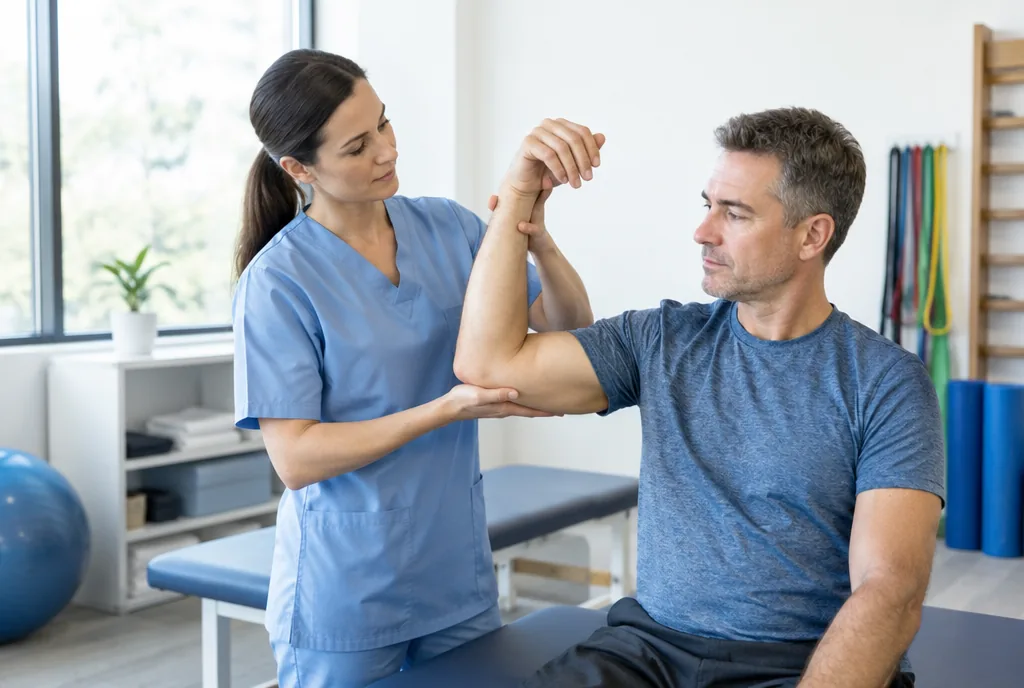
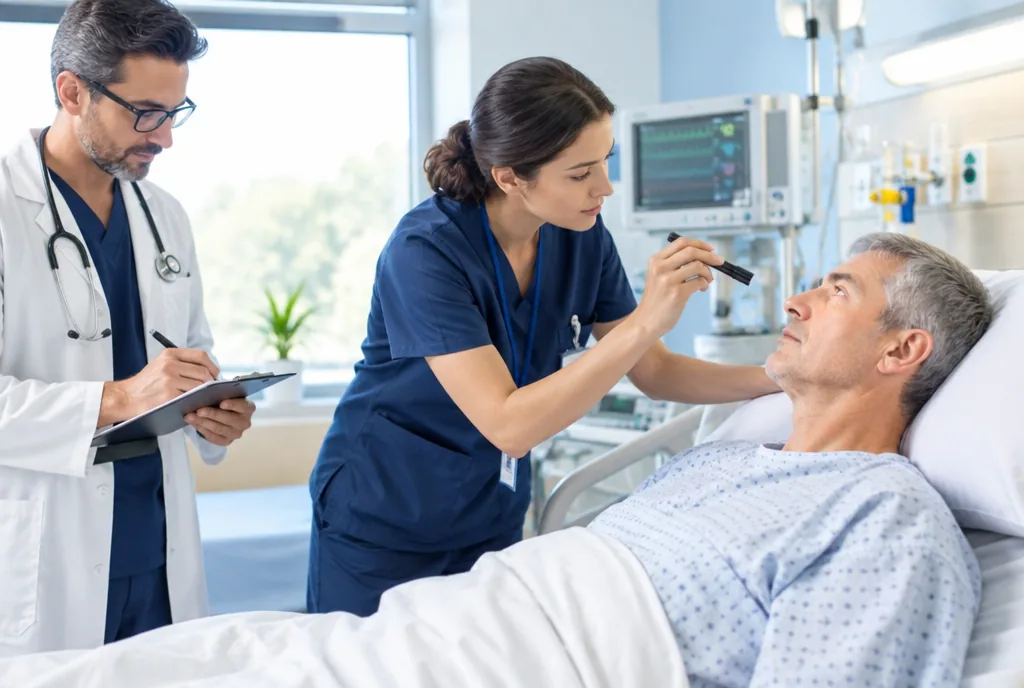
The testing details show why a standardized method matters. For item 5, the arm is held for 10 seconds at 90 degrees when seated or 45 degrees when lying down; the examiner observes whether and when it drifts. For item 6, the patient lies on their back and holds the leg at 30 degrees for 5 seconds. During visual-field testing, each quadrant is checked while the patient keeps eye contact and counts the examiner’s fingers without looking away.
What a NIHSS score can and cannot say about severity
A score of 0 means no stroke symptoms, while 42 marks the most severe end of the range. The following bands are commonly used to describe severity. They give you context, not a complete prediction for an individual.
| NIHSS score | Common description |
|---|---|
| 0 | No stroke symptoms |
| 1–4 | Mild stroke |
| 5–15 | Moderate stroke |
| 16–20 | Moderate to severe stroke |
| 21–42 | Severe stroke |
Each one-point increase in the baseline NIHSS score is associated with a significantly worse prognosis. People with a score of 4 or below have a high likelihood of good clinical outcomes. Still, read a score alongside the clinical picture, not instead of it.
Most importantly, a 0 does not rule out stroke. Strokes in the posterior circulation, including the brainstem or cerebellum, may cause nausea, vomiting, and headache while scoring low or even 0. Because the NIHSS emphasizes anterior-circulation deficits, a cerebellar infarct can receive a low number despite being clinically serious. If you notice possible stroke symptoms, seek emergency care right away.
Where the NIHSS has blind spots worth knowing
The NIHSS is deliberately focused, which leaves gaps. Its motor items examine proximal limb function through arm and leg elevation; they do not measure fine hand motor deficits. The scale also gives seven of its 42 possible points to verbal functions: two for level-of-consciousness questions, two for commands, and three for language. As a result, left-hemisphere strokes, which often affect language, tend to score higher than strokes affecting other functions.
These limits are not a reason to dismiss the scale. They are a reason not to treat a single score as the whole neurologic examination. The Modified NIH Stroke Scale, or mNIHSS, is a shortened validated version that removes items 1a, 4, and 7 and has been reported to be as accurate as, or more accurate than, the full NIHSS.
Defined rules also apply when items cannot be tested in the usual way. In a comatose patient with item 1a scored as 3, items 1b and 1c receive 2; ataxia receives 0 because it cannot be tested; sensation receives 2; language 3; dysarthria 2; and extinction/inattention 2. With ataxia set to 0, the maximum possible score in that situation is 39 rather than 42.
Why hospitals record the NIHSS early and again later
When stroke is suspected, clinicians perform the NIHSS as early as possible to establish a baseline. Later examinations then have a reference point: a change can be described against your own initial findings rather than a vague impression of better or worse.
Clinical studies commonly record the NIHSS at baseline, two hours after treatment, 24 hours after symptom onset, at 7–10 days, and at three months. In the United States, The Joint Commission requires Primary Stroke Centers to assess stroke patients with the NIHSS at admission.
The NIHSS began as a clinical-trial instrument. It has not been validated as a sole triage tool for emergency services: using the complete scale in the field does not have sufficient sensitivity or specificity for that purpose. The number supports skilled assessment; it should never delay urgent care for possible stroke.
NIHSS certification: training, testing, and renewal
Several large providers offer NIHSS certification online, including Apex Innovations (NIHSS+), the American Heart Association/American Stroke Association, and HealthCarePoint/BlueCloud. Requirements for mandatory training before the test differ between them. Each online test group, such as Group A, B, or C, includes six patient videos, and you need an 80% score to pass.
Some providers offer the certification test at no charge. The American Heart Association lists its test group at $10.30 for an individual purchase, with a stated two-hour course length and 2.0 CE credits available. In total, plan on about two to three hours for training plus testing.
| Certificate or test group | Stated validity |
|---|---|
| Test Group A | 1 year |
| Test Groups B, C, D, and E | 2 years |
| AHA test-completion certificate | Up to 1 year for compliance documentation |
A study of more than 1.3 million users found scoring accuracy stable over several years. Its authors recommended training before initial certification, recertification one year later, then every two years; after four successful recertifications, the interval could extend to three years. Remedial training was needed only when someone failed recertification. Your employer’s policy may still set the requirement you must follow.
Three common myths about the NIH Stroke Scale
“A certificate proves bedside mastery.”
Certification confirms performance in the certification process, not necessarily practical skill at the bedside. In one rural-hospital study, 32% of 114 nurses did not pass a practical NIHSS competency assessment despite completing online certification. After remedial face-to-face training, all passed.
“The score tells the whole story.”
No. A low score can miss a serious posterior-circulation stroke, and the scale does not capture fine hand deficits. The score is a standardized description of selected deficits, not a complete account of symptoms or function.
“Helping a patient try harder improves the result.”
Coaching is a common error. Repeated prompting or encouragement undermines the reproducibility that makes the NIH Stroke Scale useful. Standardized instructions and observed performance matter more than a better score in the moment.
Frequently Asked Questions
What does NIHSS stand for?
NIHSS stands for National Institutes of Health Stroke Scale, a standardized assessment of stroke-related neurologic deficits.
What is a normal NIHSS score?
A score of 0 means no stroke symptoms. Even so, it does not exclude stroke, especially a posterior-circulation stroke.
Is NIHSS certification free?
Some providers offer it free. Others charge a fee; the AHA lists an individual test group at $10.30.
How long does NIHSS stroke certification take?
Training and testing usually take about two to three hours. The AHA lists a two-hour course length for its test group.
How long does NIHSS certification last?
Test Group A is valid for one year; Groups B through E are valid for two years. An AHA test-completion certificate is valid for up to one year for compliance documentation.