Cerebellum damage can disrupt the brain’s moment-by-moment control of balance, coordination, speech, and eye movements. A person may have normal strength yet walk with a wide, unsteady base, miss a target as a hand approaches it, or develop sudden vertigo and vomiting. Those changes deserve medical assessment; sudden dizziness, headache, vomiting, or trouble walking can be a stroke emergency rather than an inner-ear problem.
What cerebellum damage changes in daily movement
Although it makes up about 10% of brain volume, the cerebellum contains more than half of the brain’s neurons, over 50 billion. It receives information from the vestibular system, proprioceptors, and vision and calibrates movement as it happens. After injury or degeneration, the result can be disproportionately disruptive: movement is not necessarily weak, but it is poorly timed, poorly scaled, or unstable.
The classic pattern, known as cerebellar motor syndrome, includes ataxia, dysarthria, nystagmus, and intention tremor. Symptoms generally occur on the same side of the body as the cerebellar lesion: a left-sided lesion affects the left side, and a right-sided lesion affects the right.
Consider reaching for a coffee cup. With intention tremor, the hand may shake more, not less, as it gets closer to the handle. The person may spill the drink, then need a wider stance to turn and carry it across the kitchen. That sequence illustrates why cerebellar symptoms can affect many ordinary tasks even without paralysis.
Symptoms that distinguish ataxia from weakness
Ataxia impairs coordination without causing paralysis. Cerebellar gait ataxia often looks broad-based and unsteady; heel-to-toe walking may not be possible. Unlike a tremor at rest, an intention tremor becomes stronger as a finger nears a target during a finger-to-nose task. Multi-joint movements can break into separate pieces instead of flowing as one action, a pattern called decomposition.
- Balance and coordination: difficulty standing, walking, turning, or coordinating several joints smoothly.
- Speech: ataxic dysarthria can sound slow, scanning, and irregular in loudness or emphasis. Articulation, voice production, and prosody can all be affected.
- Eyes: nystagmus is an involuntary rhythmic eye movement. Gaze-evoked nystagmus, which appears while looking to the side, is the most common cerebellar type.
- Trunk control: with trunk ataxia involving the cerebellar vermis, someone may be unable to sit unsupported while showing relatively little ataxia during isolated limb tasks.
Not all cerebellar changes are motor changes. Cerebellar cognitive affective syndrome (CCAS), also called Schmahmann syndrome, can involve executive function, spatial cognition, and affect regulation. Clinicians may use the Scale for the Assessment and Rating of Ataxia (SARA) to track gait, stance, sitting, speech, finger-to-nose performance, and leg movements over time. A score can quantify change, but it does not replace the person’s own goals and daily experience.
Sudden symptoms need emergency care, not a wait-and-see approach
Of the roughly 600,000 strokes that occur annually in the United States, cerebellar strokes account for about 2% to 3%. Their cardinal symptoms are vertigo, headache, vomiting, and ataxia. Because one-sided weakness may be absent, a cerebellar stroke can be harder to recognize than the stroke many people expect.
Call emergency services or seek emergency evaluation immediately if sudden severe dizziness occurs with headache, vomiting, new inability to walk safely, or other sudden neurologic changes. Declining consciousness, new brainstem signs, progressive hydrocephalus, and an infarct involving the vermis are associated with a poor course. This is not a situation for testing home balance exercises.
Several conditions can cause cerebellum damage
Ischemic or hemorrhagic stroke is one cause, but not the only one. Others include multiple sclerosis, alcohol-related degeneration, tumors, medication side effects from antiseizure medicines or lithium, and inherited conditions such as spinocerebellar ataxias. Traumatic brain injury can also damage the cerebellum, particularly with acceleration-deceleration trauma, because it sits at the base of the skull.
Multiple sclerosis often involves the cerebellum: cerebellar symptoms occur during the disease course in 80% to 90% of people with MS. In one MRI study of 73 people, average cerebellar gray-matter volume was 91.8 cm³ in relapsing-remitting MS and 88.8 cm³ in secondary progressive MS, compared with 100.1 cm³ in controls. That finding helps explain why coordination and fine motor function may be meaningful parts of MS assessment.
A rehabilitation plan addresses more than walking
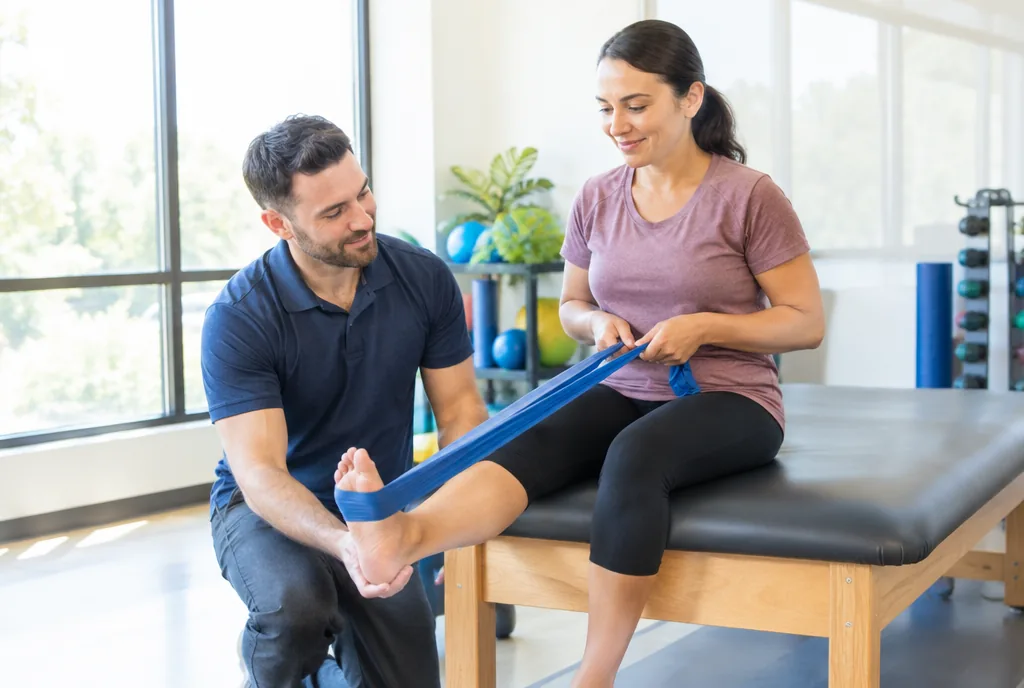
Because the effects may involve mobility, hand use, speech, swallowing, and cognition, cerebellar rehabilitation is interdisciplinary. Physical therapy works on gait, balance, and coordination. Occupational therapy addresses fine motor skills and activities of daily living. Speech-language therapy can address dysarthria and swallowing. Cognitive and affective changes associated with CCAS can be assessed and treated through neuropsychology.
Rehabilitation often relies on neuroplasticity, the nervous system’s ability to form new connections through repetitive, task-oriented practice. The useful question is not only “Can this person walk farther today?” but also whether the task is safe and whether the foundation for coordinated movement is in place.
| Rehabilitation focus | What it can address |
|---|---|
| Physical therapy | Gait, balance, coordination, trunk stability |
| Occupational therapy | Fine motor skills and daily activities |
| Speech-language therapy | Dysarthria and swallowing |
| Neuropsychology | Executive, spatial, and affective changes linked to CCAS |
In a study of 58 rehabilitation patients, mean Functional Independence Measure (FIM) scores rose from 65.5 at admission to 89.8 at discharge; the median FIM was 123.5 at an average 19.5-month follow-up. These group results show that substantial functional improvement can occur. They cannot predict an individual outcome.
Ataxia physical therapy starts with a stable base
Ataxia physical therapy commonly progresses from controlled positions to more demanding ones. Frenkel exercises are a standardized coordination approach that moves from lying down to sitting, standing, and walking. Early in the progression, a heel slides along the bed toward the buttock and back; more complex movements follow only when the current level is controlled.
Moving on to outdoor walking too early is a common rehabilitation error. Proximal stability comes from trunk and hip strength; without that foundation, distal coordination in the legs and arms is harder to train. When a therapist considers it appropriate, the Bird Dog exercise can train trunk stability and coordination: from hands and knees, the person lifts one arm and the opposite leg and holds the position for about three seconds on each side.
Sit-to-Stand practice can begin from a higher seat and progress to lower or more dynamic surfaces. Balance work may use changing surfaces such as a soft mat, wobble cushion, or balance board to challenge visual, vestibular, and proprioceptive input. Body-weight-supported treadmill training has been reported to improve gait pattern and walking speed in cerebellar ataxia. Systematic reviews have also found physical therapy associated with reduced SARA scores.
Vestibular rehab can train dizziness and gaze stability
Vestibular rehabilitation builds central compensation through repeated, symptom-provoking movements. Cawthorne-Cooksey exercises are organized into four stages; they begin slowly, and speed is increased gradually. Patient guidance describes performing them three times daily, but the right progression depends on safety and professional direction. Anyone with a fall risk should not practice standing exercises alone.
| Stage | Focus |
|---|---|
| 1 | Eye movements with the head still |
| 2 | Head-and-eye movements while sitting |
| 3 | Arm and trunk movements while sitting |
| 4 | Arm and trunk movements while standing |
Gaze-stabilization work trains a person to fix their eyes on a stationary object while the head moves. That skill is especially relevant for cerebellar nystagmus, where eye movement can interfere with visual stability. Stage 4 can include standing and sitting with eyes open or closed, throwing and catching a ball, and walking on slopes or stairs; those tasks make supervision and individualized progression important.
Alcohol can damage the cerebellum, and nutrition matters too
Alcohol-related cerebellar degeneration is the most common acquired toxic ataxia. It typically appears in middle age and often begins with gait ataxia because the anterosuperior cerebellar vermis is preferentially affected. Before arm and leg involvement, gait and trunk instability can emerge.
Both direct alcohol neurotoxicity and thiamine (vitamin B1) deficiency contribute to the process. A defining tissue finding is Purkinje-cell loss in the cerebellar cortex. With continued alcohol use, ataxia almost always worsens, while abstinence can stop further damage. The same clinical and pathological pattern has also been described in malnutrition without alcohol use, so the finding alone is no reason to make assumptions about someone’s life.
Care includes alcohol abstinence, thiamine replacement, nutritional optimization, and gait training. A medical team can evaluate the cause of new or progressive unsteadiness and determine whether these steps apply.
Recovery is possible, but myths can get in the way
Recovery after cerebellar damage varies with the cause and clinical features. After cerebellar infarct, recovery is most favorable when the initial syndrome is vertigo, vomiting, ataxia, and headache without brainstem involvement. In a study of 282 patients, 69% were independent at three months, 26% were partly or fully dependent, and 5% had died. Poorer functional recovery is predicted by preexisting comorbidities, impaired consciousness at onset, and infarct in the superior cerebellar artery territory.
Rehabilitation stays also vary by cause: average stays were 21.9 days after cerebellar infarct and 35.4 days after cerebellar hemorrhage. After rehabilitation, 62.1% of patients were discharged home, while 17.2% were discharged to a nursing home and 17.2% returned to acute hospital care.
- Myth: “It is only clumsiness.” Ataxia can signal a serious neurologic condition, including stroke.
- Myth: “No weakness means it cannot be stroke.” Cerebellar stroke may cause vertigo, headache, vomiting, and ataxia without hemiparesis.
- Myth: “Walking should be the first goal.” Trunk stability and balance may need attention before more open, demanding walking tasks.
- Myth: “Recovery is all or nothing.” Functional gains can occur with rehabilitation, while individual outcomes remain variable.
Frequently Asked Questions
What happens if the cerebellum is damaged?
Damage can cause ataxia, dysarthria, nystagmus, and intention tremor. It may also affect executive function, spatial cognition, and affect regulation through CCAS. The symptoms usually appear on the same side of the body as the lesion.
What are the most common causes of cerebellum damage?
Causes include ischemic or hemorrhagic stroke, multiple sclerosis, alcohol-related degeneration, tumors, medication effects, inherited ataxias, and traumatic brain injury.
Can you recover from cerebellar damage?
Meaningful functional improvement is possible with rehabilitation, including repetitive task-oriented practice. Recovery varies, and group statistics cannot forecast an individual person’s result.
Can alcohol damage the cerebellum?
Yes. Alcohol-related cerebellar degeneration is the most common acquired toxic ataxia. Continued alcohol use almost always worsens ataxia; abstinence can stop further damage, alongside thiamine, nutrition, and gait-focused care.
What does rehabilitation look like?
It can include physical therapy for gait and balance, occupational therapy for daily tasks, speech-language therapy for speech and swallowing, and neuropsychology for cognitive or affective changes. A plan should be tailored and progressed safely.