Locked-in syndrome is a rare neurological condition in which a person remains awake and conscious but loses nearly all voluntary muscle movement, often retaining only eye movement or blinking. It usually follows damage in the brainstem, and it can look like unconsciousness unless clinicians carefully test for a reliable response. If someone you love has LiS, that mismatch between an alert mind and a body that cannot respond is why early recognition, communication, and neuro-rehabilitation matter so much.
Locked-In Syndrome: Awareness Remains While Movement Is Lost
What is locked-in syndrome?
Locked-in syndrome, often shortened to LiS, is also called ventral pontine syndrome, de-efferented state, pseudocoma, or cerebromedullospinal disconnection. The term was first introduced by Plum and Posner in 1972. A person with LiS is conscious and awake, yet paralysis prevents voluntary movement of the limbs and most facial muscles. Quadriplegia means paralysis of all four limbs. Anarthria means an inability to produce speech. Neither finding, by itself, tells you whether a person is aware.
LiS is rare. Most often, it affects adults between ages 30 and 50, and its risk factors overlap with those for stroke. In 2013, an estimate placed the prevalence of classic LiS in Dutch nursing homes at 0.7 per 10,000 people. In France, the Association du Locked-In Syndrome reported in 2022 that more than 500 people were living with LiS. Despite that rarity, a person who cannot speak or move needs an assessment that actively looks for consciousness.
Why the brainstem changes movement but not necessarily awareness
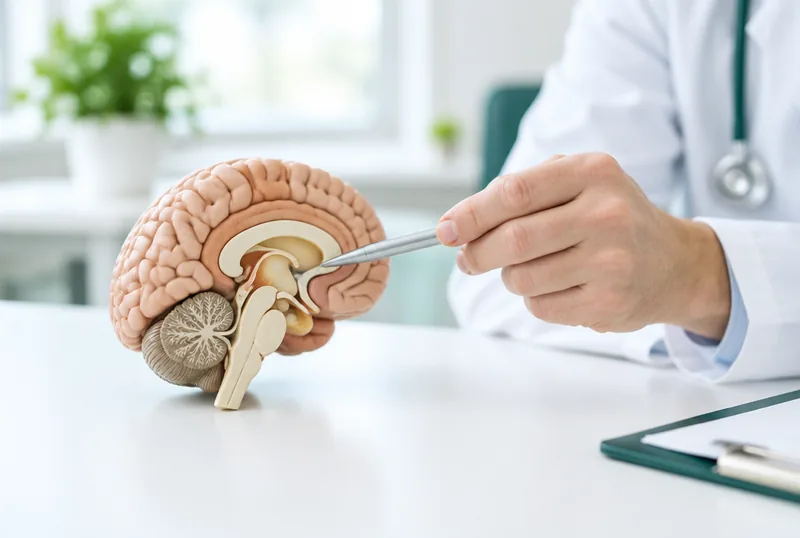
The key injury site is the ventral pons, a section of the brainstem. Motor messages travel from the brain through the corticospinal tracts toward the spinal cord and limbs. Other messages travel through corticobulbar fibers to muscles used for speech and tongue movement. A lesion in the ventral pons can interrupt both routes. The result can be quadriplegia and anarthria even while the reticular formation, which helps maintain consciousness, remains intact.
That anatomy explains why LiS is not the same as coma. When the reticular formation is spared, awareness can remain. Even while unable to show awareness through ordinary movement, a person may hear, understand, feel touch, and have thoughts. For that reason, a lack of speech or limb movement should never be treated as proof that a person is unconscious.
Why eye movement matters
Vertical eye movement and blinking may be preserved because the structures that control them lie outside the pons. Horizontal eye movement can be lost when the abducens nucleus and the paramedian pontine reticular formation within the pons are damaged. The muscle that lifts the upper eyelid is controlled through the oculomotor nerve, so eyelid opening and blinking may remain possible.
In classic LiS, a deliberate blink or upward glance can become the first route to communication. For example, a clinician may ask for one blink to mean “yes” and two blinks to mean “no,” then repeat the question to see whether the response is consistent. A small, repeatable signal gives the person a way to take part, and it can change care planning.
What Causes Locked-In Syndrome?
Stroke is the leading trigger
Most often, locked-in syndrome follows an ischemic or hemorrhagic stroke affecting the vertebrobasilar circulation in the ventral pons. In a 1986 series of 139 cases, infarction of the ventral (basal) pons was the leading cause, accounting for 82 cases. In a French survey of 44 people with LiS, 86.4% had had a stroke and 13.6% had traumatic brain injury.
Stroke-related LiS is a medical emergency. If you notice sudden, severe loss of movement, speech, or the ability to respond in someone, call 911 right away. Do not try to decide at home whether the person is conscious or has LiS; that question needs a rapid clinical assessment.
Other causes clinicians consider
Stroke does not cause every case. Reported causes include tumors in the pons, amyotrophic lateral sclerosis, Guillain-Barré syndrome, multiple sclerosis, traumatic brain injury, encephalitis, and medication overdose. Rarely, LiS has also been reported after SARS-CoV-2 infection. In individual case reports, measles encephalitis and cervical chiropractic manipulation have been described as nonvascular causes.
Substance misuse can raise stroke risk and may therefore increase LiS risk indirectly. The cause matters because recovery patterns differ between vascular and nonvascular cases. It also matters because the person and you as family need clear information about what happened, what communication is available now, and what rehabilitation goals are realistic.
Careful Assessment Can Prevent a Missed Diagnosis
The three forms of LiS
Classic LiS involves quadriplegia with preserved vertical eye movement. Incomplete LiS includes some additional residual motor function. Total LiS involves complete immobility, including loss of eye movement. A related term, locked-in-plus syndrome, describes LiS with an additional disorder of consciousness. These categories help clinicians describe what movements and responses remain; they do not predict one identical outcome for every person.
| Form | What may remain | Why it matters |
|---|---|---|
| Classic LiS | Vertical eye movement and blinking | These signals can support communication. |
| Incomplete LiS | Additional residual motor function | Even small movement can expand communication and therapy options. |
| Total LiS | No voluntary movement, including eye movement | Communication may require methods that do not depend on eye movement. |
Why repeated assessment is necessary
LiS can be mistaken for unconsciousness. In one report, diagnosis occurred an average of 78.76 days after the event. Such a delay is a reminder that a person with severe motor impairment may not be able to show awareness in an expected way. Through repeated, structured assessment, clinicians have more opportunities to identify a consistent eye or eyelid response.
For assessing disorders of consciousness, the Coma Recovery Scale-Revised is the gold standard. It is especially useful when a person’s motor limits make ordinary bedside interaction unreliable. Even without speech or limb movement, a person who follows the same blink-based instruction repeatedly may be showing a meaningful pathway for communication. If you notice such a response at the bedside, tell the care team.
Communication Is the First Rehabilitation Priority
In LiS rehabilitation, establishing a communication system is the priority. This is not a secondary convenience. Through reliable communication, a person can indicate pain, cold, preferences, and participation in daily decisions. The best system depends on the movement, vision, and sensory abilities that remain. As abilities change, the system may change too.
Start with the simplest workable signal
The simplest approach is partner-assisted scanning. A helper lists letters in a frequency-based order, and the person blinks at the chosen letter. Although slow, the process gives language back to someone who cannot speak. After a brainstem stroke caused LiS, Jean-Dominique Bauby, former editor-in-chief of French Elle, used this method. Communicating only with his left eyelid, he created a 130-page memoir through about 200,000 blinks. For the work, he spent about 2 minutes per word, 3 hours per day, over 2 months.
Before or alongside electronics, a low-tech communication board can be useful. For basic questions about pain or cold, a cardboard board was reported to be 3 times faster than complex electronic equipment. This comparison is not an argument against technology. Instead, it shows that the fastest method for a simple need may be the one that is ready and understandable in that moment.
Eye tracking can turn gaze into a screen command
Using a camera, eye-tracking systems follow eye position and translate it into screen commands. For classic LiS, they are the standard communication method. When vertical gaze and blinking are reliable, eye tracking can offer a more direct route to letters and choices than a partner spelling through an alphabet.
An auditory brain-computer interface can speak letters aloud and use an eye response. It may be useful when vision is declining. The purpose remains the same across methods: create a response that is accurate enough for the person to be understood.
When eye movement is unavailable
Even complete locked-in state does not always rule out communication. Through EEG-based brain-computer interfaces, including P300 spellers, communication can be supported even when eye movement is unavailable. In people with LiS, invasive intracortical brain-computer interfaces have reached writing speeds of 3.07 to 6.88 correct characters per minute. NINDS-funded researchers are also working on a device intended to decode speech signals directly from the brain and turn them into spoken words.
These approaches do not erase the need for a basic communication plan. A blink code, a board, eye tracking, or a brain-computer interface should be selected around the person’s available responses. The central question is practical: what signal can this person give reliably today?
Rehabilitation Turns Small Returns Into Practical Gains
Early multidisciplinary care has a measurable role
Early multidisciplinary rehabilitation, started on average about one month after the event, is associated with better outcomes and lower mortality. In work by Casanova and colleagues, rehabilitation begun within one month was associated with a 5-year mortality of 14%. At the time of one survey, almost half of people with LiS reported receiving no treatment, leaving substantial rehabilitation potential unused.
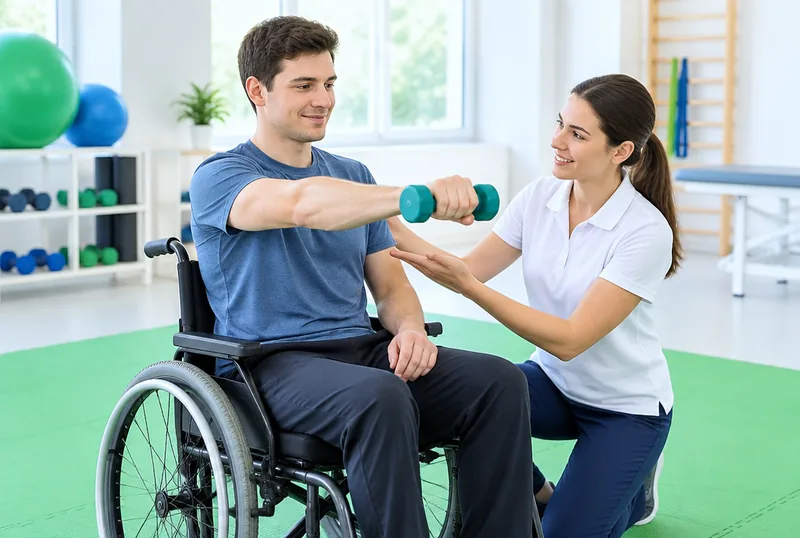
Rather than promising one outcome, rehabilitation identifies preserved abilities, supports recovery, and makes each gain useful. Repetitive sensorimotor training is recommended. Family involvement raises the chance of returning home, so you are part of the rehabilitation team, not an observer outside it.
What the rehabilitation team works toward
- Reliable communication: establish a signal or system the person can use consistently.
- Small motor returns: watch for thumb, finger, head, and neck movement.
- Swallowing: work toward independent swallowing where recovery makes that possible.
- Breathing: track and support improved respiratory function.
- Daily control: address bladder and bowel function and other practical goals that shape independence.
- Family participation: include relatives in the plan because their involvement is linked with a greater chance of return home.
Can a person recover from locked-in syndrome?
Recovery can continue over years. In a series of 14 people after 3 to 6 months of neuro-rehabilitation, 21% had motor recovery, 42% recovered swallowing, 28% regained verbal communication, and 35% regained bladder or bowel control. These results describe one small series, not a forecast for an individual person.
A survey of people living with chronic LiS found functional movement had returned in 72%; distal functions such as finger and thumb movement were more likely to return than proximal movement. In another comparison, recovery occurred in 18 of 34 people with nonvascular LiS and 29 of 105 with vascular LiS. Of the nonvascular group, 12 achieved full recovery within 6 months. Among people who survived the first 4 months, 13 of 16 reached moderate to complete functional recovery. The cause of LiS therefore matters, but no percentage can substitute for an individual rehabilitation assessment.
Survival Depends on the Early Course and Ongoing Support
The early months are particularly important. In the Patterson and Grabois series, 83 of 139 people died, with most deaths occurring in the first 4 months. Pneumonia, respiratory arrest, pulmonary embolism, and extension of the brainstem lesion were the four most common causes of death. These figures show why medical care after a severe brainstem injury needs close attention; they do not predict what will happen to one person.
How long can someone live with locked-in syndrome?
For some people, LiS lasts for decades. One documented case involved 27 years of survival after a viral infection. Among people who survive the first year, reported 5-year survival is 79% to 87%. Ten-year survival was 73% in a Norwegian study and 83% in older U.S. data. A corrected Kaplan-Meier analysis reported 56% survival at 10 years and an estimated 31% at 20 years. With good support, the Cleveland Clinic describes 10 to 20 years as a realistic range.
Because survival statistics come from different groups and methods, they should be read as ranges, not deadlines. In one comparison, vascular cases had higher mortality than nonvascular cases: 67% versus 41%. Ask the rehabilitation and medical team how the cause, early course, and current needs relate to your loved one’s situation.
Aware Does Not Mean Without a Life: Common Myths Corrected
Myth: a person with LiS is unconscious
In classic LiS, consciousness can remain intact. What the nervous system has lost are pathways needed for voluntary movement, not necessarily the capacity for awareness. Rather than assuming silence means unconsciousness, a careful assessment should look for vertical eye movement, blinking, or other repeatable responses.
Myth: communication is impossible
Communication may begin with a single blink. Partner-assisted scanning, communication boards, eye-tracking systems, and brain-computer interfaces offer different paths. The method must fit the person’s abilities, and it may be slow. Slow communication is still communication.
Myth: recovery stops after the first months
Some recovery continues over years, possibly through reorganization of descending pathways in the brainstem. Early rehabilitation is associated with better outcomes, but later changes can still matter. Small gains in a finger, thumb, neck, swallowing, or breathing function can have practical value.
Myth: life cannot be satisfying
LiS can involve profound losses, and the experience is individual. Still, long-term reports show social life and satisfaction are possible. In one group of 12 people living with LiS for more than 10 years, 7 said they were satisfied with life and the depression rate was 12.5%. In another survey, 73.2% said they enjoyed going out and 81% met friends at least twice a month. Nearly all reported that they could feel touch everywhere on the body.
Frequently Asked Questions
What triggers locked-in syndrome?
The leading trigger is an ischemic or hemorrhagic stroke in the vertebrobasilar circulation affecting the ventral pons. Traumatic brain injury and several nonvascular conditions can also cause LiS. If you see sudden loss of movement or speech, call 911.
What causes locked-in syndrome?
LiS results from injury to the ventral pons that interrupts motor pathways while awareness may remain intact. Stroke is the most common cause; reported alternatives include pontine tumors, ALS, Guillain-Barré syndrome, multiple sclerosis, encephalitis, traumatic brain injury, and medication overdose.
Can a person recover from locked-in syndrome?
Recovery is possible, but it varies greatly. Some people regain movement, swallowing, speech, or bladder and bowel control, and recovery can continue for years. Rehabilitation data describe groups, not a guarantee for any one person.
What famous person had locked-in syndrome?
Jean-Dominique Bauby had LiS after a brainstem stroke at age 43. Using partner-assisted scanning with his left eyelid, he dictated The Diving Bell and the Butterfly, a 130-page memoir.
How long can someone live with locked-in syndrome?
Some people live for decades. Among those who survive the first year, 5-year survival has been reported at 79% to 87%, while published 10-year figures range from 56% to 83% depending on the analysis. For an individual outlook, talk with the medical and rehabilitation team.