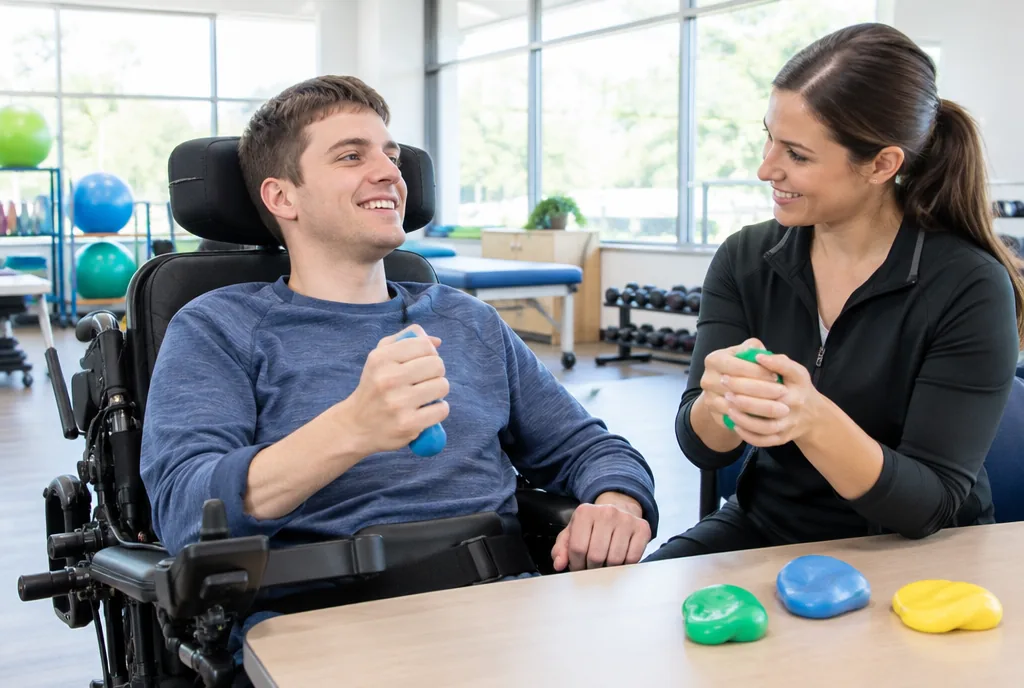
The Berg Balance Test, also called the Berg Balance Scale (BBS), is a 14-item performance test that turns everyday actions such as standing up, turning, reaching, and stepping into an objective picture of functional balance. In about 15 to 20 minutes, it helps a clinician document how safely a person manages standing and transitions. If you are in rehabilitation after a stroke or traumatic brain injury, you may meet this test early on. Your score is one piece of an assessment, not a diagnosis or a promise about whether you will fall.
What the Berg Balance Test Measures and What It Leaves Out
Canadian physical therapist Katherine Berg developed the BBS in 1989 for older adults, with the original aim of quantifying fall risk. It was refined from 38 potential tasks to 14 with input from 32 geriatric experts. Today, it is a standardized assessment recommended by the American Physical Therapy Association in clinical guidelines for neurologic rehabilitation and is used with people who have had a stroke, Parkinson disease, multiple sclerosis, traumatic brain injury, vestibular disorders, or a lower-limb amputation.
The scale captures both static balance and dynamic balance. Standing unsupported or standing with eyes closed tests the ability to maintain position; transferring between chairs or making a full turn tests control while moving. The tasks resemble daily demands, from rising from a chair to picking an object up from the floor. The BBS does not assess gait, upper-extremity ataxia, or fine motor control. That limitation matters: a person can have real-world walking or coordination difficulties that this standing-and-transition assessment does not capture.
If you are recovering from a stroke, the result can give your rehabilitation team a repeatable starting point and a way to discuss change over time. Lower admission scores have been associated with longer inpatient rehabilitation stays and less independence at discharge. The scale is highly reliable in older adults and people after stroke, with both test-retest and interrater reliability reported at an ICC of 0.98. Reliable does not mean complete, however; clinicians use the score in its clinical context.
How Clinicians Perform the Berg Balance Test Consistently
Consistency is the point of a standardized scale. The examiner reads the instructions verbatim, demonstrates each task before the patient performs it, and records the lowest category that applies. Giving extra assistance or changing the instructions can substantially weaken the reliability of the result. Although the test requires no special examiner training, the directions and setup are not casual details.
The setup makes the score comparable
The standard equipment is simple: a stopwatch or clock with a second hand, a ruler or tape measure marked at 2, 5, and 10 inches, two chairs, a footstool or step, and a shoe or slipper. One chair has armrests and the other does not. Chair seats should be 18 to 20 inches high. For the alternating-foot task, the step should be 7.75 to 9 inches high, roughly 20 to 23 centimeters. Those dimensions help make one assessment comparable with the next.
A small shortcut is built into the protocol
One rule illustrates why the exact process matters. If a patient earns 4 points for standing unsupported for two minutes on Item 2, Item 3, sitting unsupported, receives full credit without being performed; the examiner moves directly to Item 4. The purpose is not to make the test harder than necessary. It is to apply the published scoring rules the same way for every person.
Because the tasks include turning, reaching toward the floor, and standing on one leg, the test should be administered with appropriate clinical judgment and safety support. If you have a new balance problem, have fallen and been injured, or worry about standing or walking safely, see a doctor rather than trying to score yourself at home.
The 14 Items Build a Picture From Chair Rise to One-Leg Standing
The items are arranged from simpler to more challenging activities. Together, they show where balance becomes difficult: during a transfer, with vision removed, when the base of support narrows, or when the body must move over the feet.
- Sitting to standing: rising from a seated position without using the hands and stabilizing independently.
- Standing unsupported: standing for two minutes without holding on.
- Sitting unsupported: sitting for two minutes with arms folded, back unsupported, and feet on the floor.
- Standing to sitting: lowering into the chair with control.
- Transfers: making a pivot transfer between the chair with armrests and the chair without armrests.
- Standing with eyes closed: remaining safely upright for 10 seconds.
- Standing with feet together: holding the narrower stance for one minute without holding on.
- Reaching forward: extending an arm at 90 degrees and reaching as far forward as possible; the reach is measured in inches.
- Retrieving an object from the floor: picking up a shoe or slipper from in front of the feet and returning to standing.
- Turning to look behind: turning the trunk and head left and right while the feet stay fixed.
- Turning 360 degrees: making a complete turn in each direction.
- Placing alternate foot on a stool: placing each foot fully on the step in alternation for eight repetitions per side.
- Tandem standing: placing one foot directly in front of the other and holding the position for 30 seconds.
- Standing on one leg: standing for 10 seconds without holding on; this is the most difficult item.
These are not exercises to “pass” by pushing through unsafe movement. They are observed tasks. For example, Item 6 challenges vestibular and proprioceptive balance control by removing vision, while Item 11 shows dynamic stability during a turn. A person may do well when standing still yet lose points once a turn, a reach, or a narrowed stance is added.
Berg Balance Test Scoring Explains How 56 Points Are Built
Each of the 14 items is scored on a five-level ordinal scale from 0 to 4, for a maximum of 56 points. A 0 means the person is unable to perform the task or needs maximum assistance. A 4 means the task is performed safely and independently. The evaluator deducts points when the required time is not maintained, supervision or assistance is needed, or the task is not completed safely.
| Score | What it means on an individual item |
|---|---|
| 0 | Unable to perform the task or requires maximum assistance. |
| 1–3 | Performance falls between the two endpoints according to the item’s criteria. |
| 4 | Performs the task safely and independently. |
| 56 total | Perfect functional balance across all 14 BBS items. |
The total is easy to add, but the individual items still matter. Two people can have the same total while losing points in different places: one on chair transfers and one on turning or tandem standing. That difference gives the clinician more useful information than a total alone and can help focus rehabilitation on a specific balance demand.
Interpreting a Berg Balance Score Without Overpromising
A commonly used functional interpretation from Shirley Ryan AbilityLab places scores of 41 to 56 in the independently ambulatory range, 21 to 40 in the walking-with-assistance range, and 0 to 20 in the wheelchair-dependent range. These labels describe broad functional groupings; they do not replace an individual examination. A total of 56 is perfect performance on this scale, not proof that a person has no fall risk in every setting.
| Finding | What the research-based threshold says | Important context |
|---|---|---|
| Below 45 | Associated with increased fall risk in older adults. | It is a risk signal, not a diagnosis. |
| 42 or below | Predicted more than 90% fall risk in community-dwelling older adults. | That result applies to that population. |
| 49 or below | A fall-risk cutoff used in people after stroke. | Stroke-specific interpretation differs from older-adult thresholds. |
| 45 cutoff | 53% sensitivity and 92% specificity for falls in community-dwelling older adults. | It can miss people who later fall. |
Sensitivity of 53% means that, at the 45-point cutoff in that older-adult group, the test identified 53% of people who went on to fall. Specificity of 92% means it correctly identified 92% of people who did not fall. The contrast explains why the BBS should not be used in isolation as a fall-prediction tool. Across studies, fall-prediction cutoffs have ranged from 33 to 54 for older adults and from 46.5 to 50.5 for chronic stroke, depending on the setting and population.
What a Change in Score Can Mean During Rehabilitation
Change is most useful when it is larger than expected measurement variation. In chronic stroke, the minimal detectable change at 95% confidence (MDC95) is 5 points overall. It also depends on the starting score: 4 points for a baseline of 45 to 56, 5 points for 35 to 44, 7 points for 25 to 34, and 5 points for 0 to 24. For stroke, the estimated minimal clinically important difference is 4 to 6 points. In Parkinson disease, the reported MDC is 5 points.
Those figures answer a careful question: is a difference likely to be more than measurement noise? They do not mean every 5-point gain feels identical or changes the same daily activity for every person. A clinician can compare a person’s baseline, diagnosis, and item-level performance before deciding what the change means for therapy or safety.
Common Berg Balance Scale Misunderstandings
- “It is a walking test.” The BBS does not assess gait; it assesses standing balance and transitions.
- “One number predicts every future fall.” The scale alone has only moderate diagnostic accuracy, and cutoffs vary by population.
- “A score of 56 means there is no risk.” This ignores the ceiling effect: 7.5% to 32.5% of healthy, higher-functioning older adults can reach the maximum despite still having fall risk.
- “The BBS is only for older adults.” It was developed for older adults, but today it is used across neurologic and rehabilitation populations.
The same scale can also be too difficult at the other end. In severe impairment, including acute stroke or severe polyneuropathy, the BBS can show a floor effect. The Postural Assessment Scale for Stroke may be a better fit in that situation. For more active, higher-functioning older adults, the Community Balance and Mobility Scale or Functional Gait Assessment may be more useful because they do not show the same ceiling effect.
Frequently Asked Questions
What is the Berg Balance Test?
It is a 14-item, clinician-administered performance test of functional balance. It scores tasks such as standing, transferring, turning, reaching, and single-leg standing from 0 to 4, for a maximum of 56 points.
How do clinicians perform the Berg Balance Test?
They use standardized instructions, demonstrate each task, observe performance, and record the lowest applicable scoring category. Standard chairs, a step, a timing device, a ruler or tape measure, and a slipper are part of the setup.
What does the Berg Balance Test measure?
It measures static and dynamic balance during standing and transitions. It does not measure gait, upper-extremity ataxia, or fine motor skill, so it cannot stand in for every mobility assessment.
How long does the Berg Balance Scale take?
Administration takes about 15 to 20 minutes. If the person earns 4 points on the two-minute unsupported-standing task, the protocol awards full points for unsupported sitting and moves on to Item 4.
What is a good Berg Balance Scale score?
There is no single “good” score for everyone. A 56 is perfect functional balance on the BBS, while interpretation of lower scores depends on the person’s population, baseline, and the rest of the clinical assessment.
Can I do the Berg Balance Test at home?
The standardized assessment is designed for an examiner who can demonstrate, observe, and score the tasks safely. If your balance worries you, especially after a fall or neurologic injury, see a doctor or rehabilitation clinician for an appropriate evaluation.