Decerebrate posturing is an involuntary pattern in which the arms extend rather than bend, usually in response to painful stimulation, and it can signal a severe brain injury. In the comparison of decorticate vs decerebrate posturing, the arm position is the quickest visible difference: arms bend toward the chest in decorticate posturing and extend in decerebrate posturing. Neither is a diagnosis on its own, but either finding requires immediate emergency medical care. The pattern gives clinicians an urgent clue while they evaluate the person’s breathing, consciousness, and underlying cause.
Decorticate vs decerebrate posturing: the visible difference that matters
Abnormal motor posturing describes stereotyped, involuntary body positions that occur as a response to painful stimuli. It is a sign of severe neurologic dysfunction, not a posture a person is choosing. Both patterns can look dramatic. The most useful first distinction is what the arms do.
| Feature | Decorticate posturing | Decerebrate posturing |
|---|---|---|
| Other name | Abnormal flexion, flexor posturing | Abnormal extension, extensor posturing |
| Arms | Elbows, wrists, and fingers bend; arms draw toward the chest | Elbows extend; forearms turn downward; fingers flex |
| Shoulders | Adducted and internally rotated | Adducted and internally rotated |
| Legs and feet | Legs extend and internally rotate; feet plantar-flex | Legs extend and internally rotate; feet plantar-flex |
| Typical clinical implication | Damage above the red nucleus is classically suggested | Damage below the red nucleus is classically suggested |
| Glasgow Coma Scale motor score | M3, abnormal flexion | M2, extension |
In decorticate posturing, the shoulders move inward and rotate inward while the elbows, wrists, and fingers flex. The hips may rotate inward, the knees extend, and the feet point downward. The toes are commonly spread and hyperextended. In decerebrate posturing, the legs can look similar, but the arms extend at the elbows instead of flexing. The forearms pronate, meaning they rotate so the palms turn downward; the fingers flex. The head and neck may extend backward, and the toes may point away from the body with a slight inward turn.
The distinction is clinically important, but it is not always easy to make in an emergency. Even experienced clinicians may confuse the patterns. A person can also show decorticate posturing on one side and decerebrate posturing on the other, which can suggest an asymmetric injury.
What posturing means in an emergency
Posturing is an emergency sign. If someone has a sudden rigid, abnormal position of the arms or legs, is unresponsive, or cannot be awakened, call emergency services immediately. Do not wait to see whether the position passes. Emergency clinicians need to protect the airway, assess breathing and circulation, determine the level of consciousness, and look for a treatable cause.
People with decorticate posturing are described as unconscious or in a coma and do not respond to attempts to wake them. The same is generally true of people with decerebrate posturing. A rare form of decerebrate rigidity with preserved consciousness has been documented, but it does not make the sign less urgent. An observer should not try to decide the cause or severity from the position alone.
Decerebrate posturing is a tonic reflex rather than a continuous muscle contraction. Muscle tone can return toward normal between episodes. That change does not rule out a serious problem. The clinical team interprets the response with the rest of the examination and the person’s overall condition.
Which brain areas can decerebrate posturing signal?
Classically, decerebrate posturing points to dysfunction in deeper brainstem structures, often the lower midbrain or pons. Decorticate posturing is classically associated with damage higher up, including the cerebral cortex, thalamus, or upper midbrain tegmentum. The difference is often explained in relation to the red nucleus, a structure in the midbrain: decorticate posturing suggests a lesion above it, while decerebrate posturing suggests a lesion below it.
This framework helps explain the arm positions. In decorticate posturing, the rubrospinal tract remains active and promotes flexion in the upper limbs, while the vestibulospinal tract promotes extension in the legs. In decerebrate posturing, injury can reduce the flexion-promoting influence of the rubrospinal tract. Vestibulospinal and pontine reticulospinal pathways then favor extension. Decerebrate rigidity is classically linked with a lesion between the red nuclei and the lower vestibular nuclei.
Still, the labels should not be treated as a precise map of one damaged spot. The terms “decorticate” and “decerebrate” are increasingly criticized because real-world injuries are often diffuse and do not fit one clean anatomic boundary. Posturing is one piece of a broader neurologic assessment, not a substitute for that assessment.
How the Glasgow Coma Scale puts the movement in context
The Glasgow Coma Scale, or GCS, gives clinicians a common way to describe consciousness after an acute brain injury. Graham Teasdale and Bryan Jennett developed it in 1974. The scale combines three responses: eye opening, with up to 4 points; verbal response, with up to 5 points; and motor response, with up to 6 points. A total score can range from 3 to 15.
Posturing changes the motor portion of the score. Decorticate posturing is abnormal flexion, scored as M3. Decerebrate posturing is extension, scored as M2. For decorticate posturing, the M3 definition includes at least two findings such as inward forearm rotation, thumb adduction, maximum wrist flexion, or associated leg extension. A total GCS of 8 or lower on admission is considered severe traumatic brain injury.
The motor component is the strongest individual GCS predictor of survival after traumatic brain injury. That does not mean one score can determine a person’s future. It does mean a change from flexion to extension, or a change in any motor response, deserves prompt attention and careful documentation. For children age 5 and older, the standard GCS can be used unchanged.
Why decerebrate posturing is usually considered more serious
Decerebrate posturing is generally considered more serious than decorticate posturing because it suggests deeper, more caudal brainstem involvement. The lower the classic lesion location in this model, the more critical the neurologic concern. That comparison is useful, but it should never become a shortcut for predicting one individual person’s outcome.
For traumatic brain injury, the reported numbers are stark. One summary found survival in 10% of patients with decerebrate posturing and 37% of patients with decorticate posturing. Other studies reported mortality of 68% to 83% among traumatic brain injury patients with decerebrate posturing. In a meta-analysis of severe blunt traumatic brain injury, 72% of patients with decerebrate posturing had a fatal outcome and 16% reached a good outcome. For children with severe traumatic brain injury and decerebrate posturing, reported mortality reached 71%.
These are population findings from particular traumatic brain injury groups, not a survival calculator. The cause, the type of bleeding or injury, age, timing of care, and response to treatment all matter. In subarachnoid hemorrhage, for example, decerebrate posturing appears in Hunt and Hess grades 4 and 5, which carry reported mortalities of 42% and 77%, respectively. A clinician can explain which evidence applies to a specific situation.
Can someone recover from decerebrate posturing?
Recovery is possible in some situations, particularly when the cause is reversible. Examples include a treatable infection, a tumor that can be removed, or a correctable metabolic problem. A documented case described full recovery within one month after evacuation of a right-sided parenchymal hematoma that was compressing the brainstem. Such cases show why rapid evaluation for treatable causes matters.
At the same time, decerebrate posturing carries a grave prognosis. Most people with this finding do not survive, and neurologic recovery is often incomplete among survivors. In people over age 60, recovery rates are significantly lower than in younger people. After traumatic brain injury, younger age, arrival at the hospital within 6 hours of injury, and an extradural hematoma are favorable factors. An acute subdural hematoma is associated with a worse outlook.
Hypoxic brain injury needs particular caution when discussing prognosis. When abnormal flexion or extension produces a GCS motor score below 4 on the day after a hypoxic injury, the chance of independent living is described as practically absent. That statement concerns this specific clinical setting; it is not a general conclusion about every cause of posturing.
Emergency treatment comes before rehabilitation
In the acute setting, posturing calls for emergency management of the underlying cause. People with decorticate posturing may need emergency care, intubation, intensive care monitoring, and treatment directed at what caused the injury. When a hematoma is surgically removable, early neurosurgical intervention can substantially improve survival chances in decerebrate posturing.
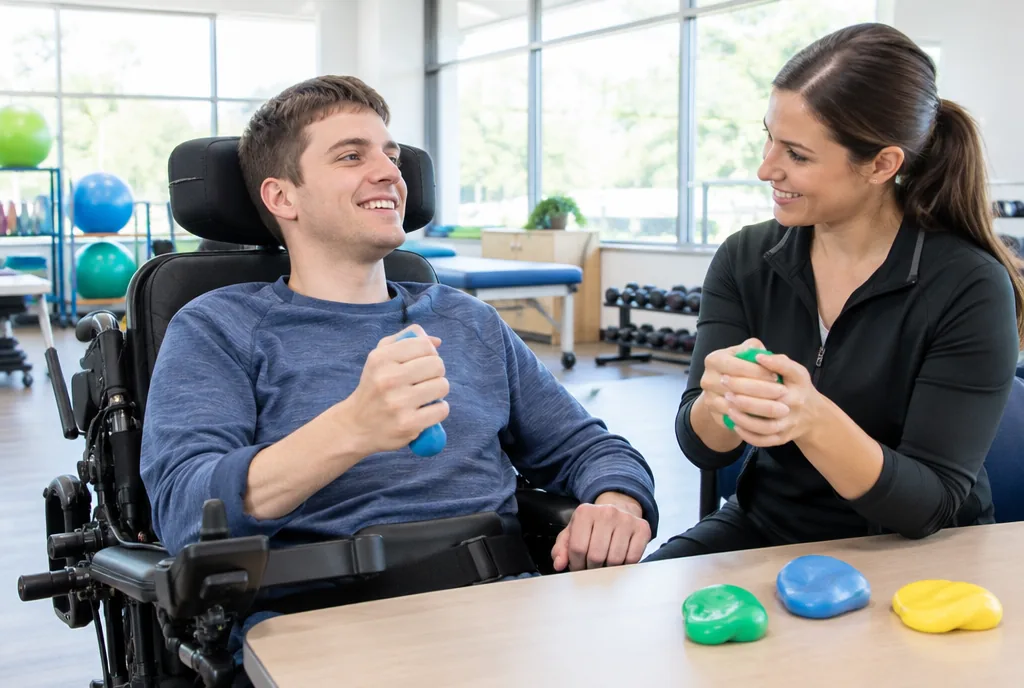
Rehabilitation begins only after the immediate medical crisis is addressed and the person survives. Physical therapy, psychological support, and assistive devices can help improve function and quality of life. The goals must be individualized because injury effects and recovery differ widely. Rehabilitation does not erase the seriousness of the original sign; it provides practical support for the abilities that remain and the goals that are still possible.
Common misunderstandings can delay the right response
“Posturing tells us exactly where the injury is.”
Not reliably. Decerebrate posturing often suggests the lower midbrain or pons, and decorticate posturing often suggests more rostral structures. Yet brain damage may be diffuse. The positions help guide an assessment but cannot precisely localize all injury by themselves.
“If the muscles relax between episodes, the danger has passed.”
No. Decerebrate rigidity is a tonic reflex, and tone can normalize between episodes. A transient pattern still needs emergency evaluation.
“Decorticate posturing is not serious because it is less severe than decerebrate posturing.”
Both are signs of severe neurologic dysfunction. The fact that decerebrate posturing is generally more concerning does not make decorticate posturing safe or suitable for watchful waiting.
“A survival statistic predicts what will happen to my family member.”
No. Published percentages describe groups, usually people with a particular type of traumatic brain injury. They cannot account for every cause, treatment opportunity, age, or clinical change in one person.
Frequently Asked Questions
What is the difference between decorticate and decerebrate postures?
Decorticate posturing features arms bent toward the chest, while decerebrate posturing features arms extended at the elbows. Both can include extended legs and plantar-flexed feet. On the GCS motor scale, decorticate is M3 and decerebrate is M2.
Can you recover from decerebrate posturing?
Recovery can occur when the cause is reversible, such as a treatable infection, a removable tumor, or a correctable metabolic disorder. A full recovery after surgical evacuation of a hematoma compressing the brainstem has been documented. However, most patients do not survive, and recovery is often incomplete in survivors.
What is the survival rate of decerebrate posturing?
For traumatic brain injury, one report found 10% survival with decerebrate posturing. Other traumatic brain injury studies reported 68% to 83% mortality, and a meta-analysis of severe blunt traumatic brain injury found 72% fatal outcomes. These statistics cannot predict an individual outcome.
Is decorticate or decerebrate more serious?
Decerebrate posturing is generally considered more serious because it suggests deeper brainstem dysfunction than decorticate posturing. Both patterns are medical emergencies and require immediate evaluation.
What part of the brain is damaged in decerebrate posturing?
Decerebrate posturing commonly suggests dysfunction in the lower midbrain or pons, classically below the red nucleus. Because injuries can be diffuse, the posture cannot identify one exact damaged area on its own.