Pusher syndrome is a post-stroke behavior in which a person actively pushes with their stronger, non-paretic arm or leg toward the weaker, paretic side. It can make sitting, standing, transfers, and walking feel unexpectedly unsafe. The reason is not that the person is refusing help, but that their sense of being upright has changed. Also called contraversive pushing, it needs a careful clinical assessment and a rehabilitation plan that uses the person’s intact visual sense of vertical.
Pusher syndrome makes “upright” feel tilted
The most recognizable sign is a trunk that leans spontaneously toward the paretic side. When someone tries to bring the person back to midline, the person may push away with the non-paretic limbs and actively resist the correction. These three features—spontaneous tilt, active pushing, and resistance to passive correction—are the core clinical signs described for pusher syndrome.
Imagine a person sitting at the edge of a bed after a stroke. Their body is visibly tilted toward the weaker side. A therapist gently guides the trunk toward a more vertical position, but the person pushes with the stronger arm or leg in the opposite direction. From the person’s perspective, that correction can feel wrong because their internal reference for upright has shifted.
This pattern differs from a hemiparetic person who loses balance, recognizes the loss, and tries to hold on. That response is sometimes described as pulling. Contraversive pushing is the opposite problem: the person actively drives the body toward the paretic side.
Because the resulting postural instability creates a substantial fall risk, a therapist or other qualified clinician should assess suspected pushing behavior. New or suddenly worsening neurological symptoms need urgent medical evaluation.
Why a stroke can change the perceived vertical
Pusher syndrome is linked to a disturbance in the posterolateral thalamus, including the pulvinar and ventral posterior nucleus. This brain region is involved in controlling upright body posture. Research has shown that a hemorrhage in the posterior thalamus can directly cause pusher syndrome.
The key problem is the subjective postural vertical: the internal sense of how the body is positioned relative to upright. On average, people with pusher syndrome may experience their body as upright when it is tilted about 18 degrees toward the same side as the brain lesion. Yet their subjective visual vertical can remain intact. In other words, they may accurately see a doorframe or window as vertical while their body sense gives them a conflicting message.
That mismatch explains why visual feedback is so important in rehabilitation. A vertical reference in the environment can provide information that the person can still interpret correctly, even when the felt sense of body position is misleading.
Pusher syndrome can occur after either a right or left hemisphere stroke. It is not the same as neglect, although neglect is correlated with pusher syndrome after right-hemisphere lesions. Aphasia is likewise correlated after left-hemisphere lesions. These conditions can complicate therapy, but they are not the cause of the pushing behavior.
Contraversive pushing and lateropulsion describe a specific pattern
“Contraversive pushing” is the more precise term for active pushing toward the side opposite the brain lesion—toward the paretic side in a supratentorial lesion. “Pusher syndrome,” “ipsilateral pushing,” and “lateropulsion” may also appear in clinical conversations and research.
Lateropulsion is increasingly used as an umbrella term because it describes the symptom without assuming its mechanism. The distinction matters: cerebellar or brainstem lesions can produce lateropulsion toward the same side as the lesion, while lateropulsion from supratentorial lesions is contralateral. A rehabilitation team can use the observed direction, the stroke location, and the person’s movement pattern to describe what is happening accurately.
For families, the practical takeaway is simple. The behavior is real, it is not deliberate, and it is not best understood as stubbornness. Clear terminology helps the team choose assessment tools and plan safe practice.
The Scale for Contraversive Pushing turns observations into a score
Clinicians often use the Scale for Contraversive Pushing (SCP), developed by Karnath, Ferber, and Dichgans, to structure their observations. The scale examines the same three components seen at the bedside: spontaneous posture, pushing, and resistance to correction. Each is rated from 0 to 2, with 0 meaning no deviation, 1 mild, and 2 severe. The total ranges from 0 to 6; an SCP score of 1 or higher meets the cutoff for pusher syndrome.
Timing matters. The SCP is assessed during position changes, ideally after moving from supine to sitting and from sitting to standing. The spontaneous posture immediately after a change is particularly informative, because it reveals how the body settles before someone tries to correct it.
| Tool | What it captures | Score and cutoff |
|---|---|---|
| Scale for Contraversive Pushing (SCP) | Spontaneous posture, active pushing, and resistance to correction | 0–6 total; 1 or higher is the cutoff |
| Burke Lateropulsion Scale (BLS) | Rolling, sitting, standing, transfers, and walking | 0–16 total; 2 or higher is the cutoff |
The Burke Lateropulsion Scale looks across five functional activities. Its standing item is scored from 0 to 4, while the other items are scored from 0 to 3. The SCP and BLS do not always classify people in the same way; the BLS may describe lateropulsion as a continuum more precisely. A score is therefore not a substitute for the clinician’s full movement assessment.
Visual feedback gives rehabilitation a usable reference
The most frequently cited specific approach, developed by Broetz and Karnath, uses visual information to guide the person back toward vertical. Rather than repeatedly trying to force a passive correction, therapy helps the person see the difference between felt upright and actual upright, then practice an active correction.
- The person visually explores the surroundings and identifies vertical references, such as a therapist’s arm, a doorframe, a window, or a pillar.
- They practice the movements needed to reach a vertical body position.
- They perform functional activities while maintaining that vertical position.
- They learn to recognize the altered perception of upright and the corrective movements it requires.
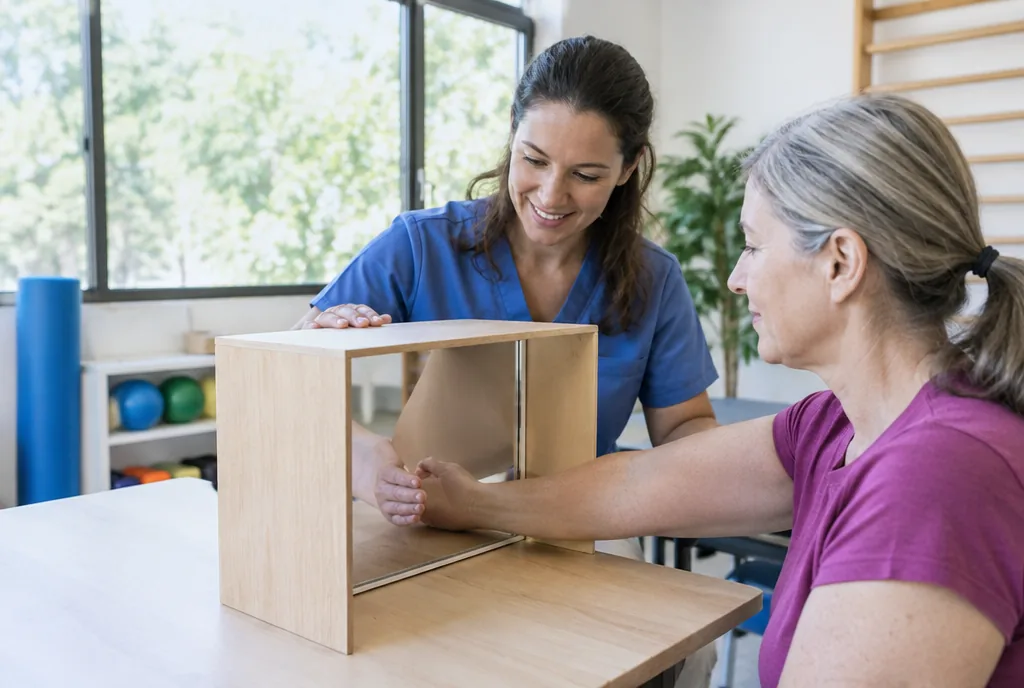
A mirror can offer direct visual feedback about the body’s actual axis. In one simple sitting exercise, the stronger side is placed near a vertical wall and the person is asked to lean toward the wall. The task uses intact visual control rather than relying only on the misleading internal sense of upright.
In a pilot randomized controlled trial, interactive visual-feedback training with a laser or screen, given five times a week for four weeks, significantly improved pusher behavior. Robot-assisted gait training has also reduced pusher behavior in a randomized controlled trial. These approaches belong in an individualized rehabilitation program, not a one-size-fits-all home routine.
Sitting, standing, and transfers need practice that stays safe
Rehabilitation often begins with sitting balance on a bed or mat while using visual references. It can then include transfers with mirror feedback and standing at parallel bars while the person receives feedback about their body axis. The goal is not for a therapist to hold someone upright indefinitely. It is for the person to use the visual reference and actively take over the correction.
Passive straightening can provoke the characteristic resistance to correction. This is why an approach based on “just push them upright” can work against the treatment goal. Instead, the clinician corrects only until the person can use visual feedback to continue the correction, then incorporates upright alignment into a functional task.
High postural instability makes safety central at every stage. Pusher behavior has been described as a cause of falls and instability after stroke, and lateropulsion is a strong predictor of falls during inpatient stroke rehabilitation. A therapist can decide when sitting, standing, transfers, or gait practice are appropriate and what assistance is needed.
Recovery time varies, so prognosis needs context
There is no single timeline for pusher syndrome. In a prospective cohort of 448 people, the mean duration of pusher behavior during rehabilitation hospitalization was 5 plus or minus 4.3 weeks. The median was 4 weeks, and the observed range was 1 to 20 weeks. Some authors report that the syndrome is rarely seen after six months, but severe case reports have described persistent pushing for up to 318 days.
Stroke side is one important part of the picture. Pusher behavior was found in 17.4% of people with right-hemisphere lesions and 9.5% of those with left-hemisphere lesions, a relative risk of 1.83. People with right-hemisphere lesions also recovered significantly more slowly in the reported study. They may have neglect or anosognosia, while aphasia can add difficulty after a left-hemisphere stroke.
Pusher syndrome is a negative predictor for rehabilitation efficiency and effectiveness and can extend rehabilitation by up to three weeks compared with rehabilitation without it. Longer-lasting pushing is associated with poorer functional recovery. At the same time, published findings conflict about the functional outcome at six months: some reports find no negative effect on the eventual outcome, while others describe ongoing limitations. An individual prognosis should come from the clinical team, not a timeline alone.
Four misconceptions can make care harder
| Misconception | What the evidence-based description says |
|---|---|
| “They are pushing on purpose.” | The behavior reflects altered perception of body vertical, not a choice to resist care. |
| “It is the same as neglect.” | Neglect may be correlated with pusher syndrome, especially after a right-hemisphere lesion, but it is not its cause. |
| “Forcing upright is the fastest fix.” | Passive correction can provoke resistance; visual references and active correction are central to the specific approach. |
| “It only follows a right-hemisphere stroke.” | It occurs after both right and left hemisphere lesions, although it is more prevalent and slower to resolve after right-hemisphere lesions. |
Understanding these differences changes the tone of rehabilitation. Instead of treating a tilted posture as noncompliance, caregivers can support the clinician’s safety plan and reinforce the visual cues used in therapy.
Frequently Asked Questions
What is pusher syndrome?
Pusher syndrome is a post-stroke behavior marked by a spontaneous lean toward the paretic side, active pushing with non-paretic limbs, and resistance when someone passively tries to correct the posture. It is also called contraversive pushing and is related to altered perceived body vertical.
What causes pusher syndrome?
The syndrome is associated with disruption of the posterolateral thalamus and a disturbed subjective postural vertical. A person may feel upright while tilted toward the side of the brain lesion, even though visual perception of vertical remains intact.
How long does pusher syndrome last?
In one prospective cohort, the median duration during rehabilitation hospitalization was four weeks, with a range of one to 20 weeks. Recovery varies substantially; some reports describe the syndrome as rare after six months, while severe cases may persist much longer.
How is pusher syndrome treated?
Treatment commonly uses visual feedback: vertical references in the environment, mirrors, practice reaching vertical, and functional activities performed while maintaining vertical alignment. Sitting, transfers, standing, and gait work are progressed under professional guidance because of the fall risk.
Should a family member try to straighten the person at home?
Do not treat suspected pusher syndrome as something to correct by force. Passive straightening can trigger resistance. Ask the rehabilitation team for a safe plan and for the specific visual references and assistance level appropriate for that person.