The Brunnstrom stages of stroke recovery are a classic framework for describing how movement returns after a stroke. When a stroke leaves one side of the body paralyzed or weak (hemiplegia), motor control often comes back in a predictable order. Swedish physical therapist Signe Brunnstrom described that order in seven stages, from complete flaccid paralysis to near-normal coordination. Instead of treating spasticity and involuntary movement patterns only as problems, her model sees them as steps along the way. That gives therapists and stroke survivors a shared language for setting goals, choosing exercises, and tracking progress.
Stroke warning signs
Sudden weakness on one side, a drooping face, slurred speech or sudden confusion: call 911 right away. Note the time the symptoms started and tell the emergency team.
What Are the Brunnstrom Stages of Stroke Recovery?
The Brunnstrom stages describe motor recovery after stroke in seven steps. The scale is ordinal: each stage builds on the one before, and stages cannot be skipped. The seven stages fall into four broad phases: flaccidity; spasticity with movement synergies; declining spasticity with movement outside the synergies; and isolated movement with normal coordination.
Signe Brunnstrom (1898–1988) was born Anna Signe Sofia Brunnstrom in Stockholm. She studied at the Royal Central Gymnastics Institute in Stockholm and emigrated to the United States in 1927. Her first job there was teaching gymnastics to working women at the Metropolitan Life Insurance Company. Only later did she specialize in hemiplegia rehabilitation, working at the Kessler Institute for Rehabilitation in New Jersey and teaching at Columbia University and New York University.
Brunnstrom was the first to observe that people with hemiplegia move through a predictable sequence of motor recovery. In 1966 she published the first systematic description of these stages in the journal Physical Therapy. Her 1970 book Movement Therapy in Hemiplegia: A Neurophysiological Approach is still considered the foundational text of the Brunnstrom approach. She originally meant it as a collection of clinical observations, not a closed theory; her students and publishers later turned it into the “Brunnstrom Approach.” After her death in 1988, the American Physical Therapy Association (APTA) created an award in her name for excellence in clinical teaching.
Her key idea concerns spasticity. Brunnstrom did not see it as a disorder but as a sign of neuroplasticity: it shows that signals from the brain are reaching the muscles again. While voluntary control is still missing, the model uses primitive reflexes, associated reactions, and sensory (exteroceptive) stimuli to bring out whatever movement is possible.
The Seven Stages: What Happens in Each One
- Stage 1 (Flaccidity): The affected side is completely limp. There is no muscle tone, no resistance to passive movement, and no voluntary activity. Without early care, this stage carries a risk of joint contractures, shoulder subluxation, and circulation problems.
- Stage 2 (Spasticity appears): Spasticity begins. Minimal associated reactions appear, for example through the tonic neck reflex. Voluntary movement is possible only within synergy patterns.
- Stage 3 (Spasticity increases): Spasticity peaks. The person can now perform synergy patterns voluntarily. Left untreated, muscle contractures can develop.
- Stage 4 (Spasticity declines): Spasticity drops measurably. The first movements outside the synergy patterns become possible, such as bending the elbow while the shoulder stays in a neutral position.
- Stage 5 (Complex movement returns): Spasticity keeps falling. More complex combinations, such as bringing the hand to the mouth or grasping objects, become possible. Opening and closing the hand on purpose is an important milestone for daily tasks like grasping and releasing.
- Stage 6 (Spasticity disappears): Almost no spasticity remains. Joints can be moved one at a time without other joints moving along, a sign that control from the brain is returning. Fast, complex movements are still difficult.
- Stage 7 (Normal function): Coordination, strength, and speed of movement are close to normal. Small limits in fine motor skills, such as speed in complex grasping, may remain.
Flexor and Extensor Synergy Patterns
A synergy is a fixed movement pattern in which several joints of a limb move together. Early after a stroke, a person cannot yet move single joints on their own; the whole limb moves in one of these patterns. There are flexor and extensor synergies for the arm and for the leg.
In the arm, the flexor synergy usually dominates. Its strongest parts are shoulder abduction and elbow flexion; its weakest parts are hand and finger extension. In the leg, the extensor synergy usually dominates, the pattern used for standing and walking.
| Synergy | Movement components | Notes |
|---|---|---|
| Arm, flexor synergy | Scapular retraction and elevation, shoulder abduction and external rotation, elbow flexion, forearm supination, wrist and finger flexion | Usually dominant in the arm; strongest parts are shoulder abduction and elbow flexion |
| Arm, extensor synergy | Shoulder adduction and internal rotation, elbow extension, forearm pronation, wrist flexion with finger flexion | Usually the weaker pattern in the arm |
| Leg, flexor synergy | Hip flexion, abduction, and external rotation; knee flexion; ankle dorsiflexion; inversion | Usually the weaker pattern in the leg |
| Leg, extensor synergy | Hip extension, adduction, and internal rotation; knee extension; ankle plantarflexion and inversion; toe plantarflexion | Usually dominant in the leg; linked to standing and walking |
From Stage 4 on, the person begins to suppress the opposing synergy, for example bending the elbow while the shoulder stays neutral. This prepares the way for purposeful reaching and grasping.
How the Stages Are Used in Therapy
Treatment follows a sequence from reflex movement to voluntary movement: first passive, then active-assisted, then active against resistance.
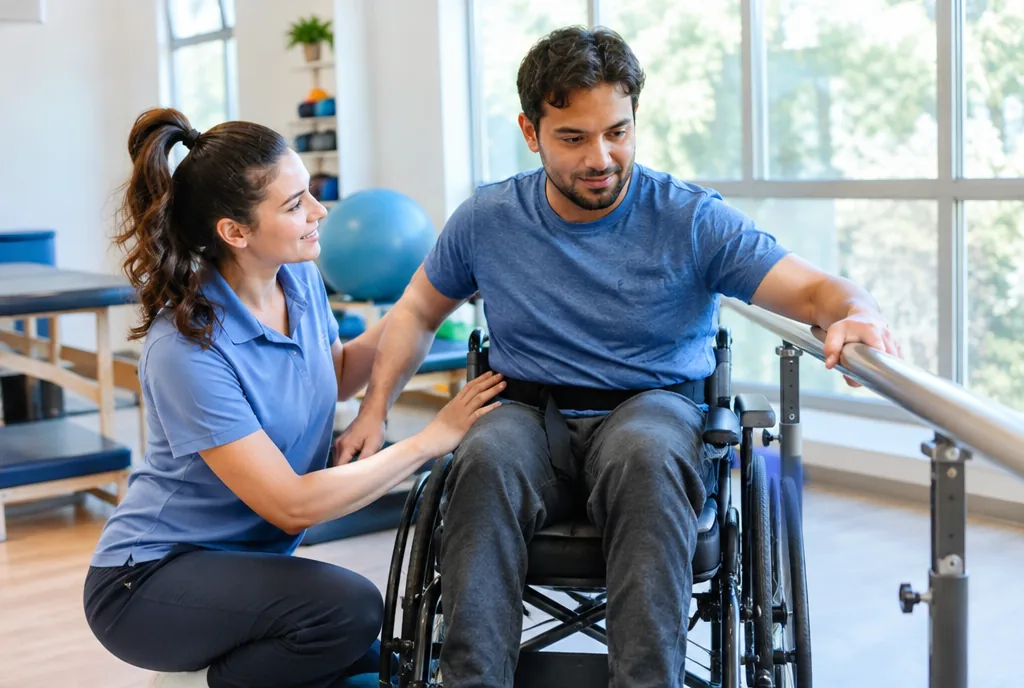
- Stage 1: Passive range of motion (PROM) to keep joints mobile, careful positioning to prevent contractures, and exteroceptive and proprioceptive stimuli to activate the muscles.
- Stages 2–3: The therapist uses associated reactions and reflexes to bring out movement. For example, resistance applied to the unaffected limb can trigger movement on the affected side. Once the person can perform synergies voluntarily, the focus shifts to active movement within the patterns, strengthening the synergy muscles, and gentle stretching against contractures.
- Stages 4–5: Training now targets movement outside the synergies, such as straightening the elbow with the shoulder abducted, and synergy reversal, switching between flexor and extensor patterns in one session. In Stage 5, combined functional movements like grasping, releasing, and hand-to-mouth are practiced, along with fine motor work for the hand.
- Stage 6: Coordination and strengthening for isolated joint movement. The person practices complex movement sequences in different settings and returns to daily and leisure activities.
- Stage 7: Keeping and building on regained function through daily activity, work, recreation, and sports, with monitoring for setbacks.
Associated reactions are used only in the first three stages. Tactile cues are the last form of help to be withdrawn.
Spasticity is a velocity-dependent increase in muscle tone and part of the upper motor neuron syndrome after stroke. When it causes pain or blocks movement, botulinum toxin (Botox) injections may be used for a time to open a window for therapy. Whether that makes sense is a decision for the treating physician.
Does Everyone Go Through All Seven Stages?
No. Not everyone goes through all seven stages, and recovery can stop at any stage. This is called arrested recovery. The chance of reaching Stage 7 is lower with older age and with more severe initial weakness.
Not everyone starts at Stage 1 either. Flaccidity usually occurs only after severe strokes, for example an infarct in the middle cerebral artery. After a mild or moderate stroke, motor recovery may begin at Stage 2 or 3.
Mixed stages are common: the arm might be in Stage 2, the hand in Stage 3, and the leg in Stage 4. Each limb recovers partly on its own. The speed of recovery depends on where the stroke happened, how large it was, the person’s age, and when rehabilitation started, so it varies a lot from person to person.
Assessment Tools Based on Brunnstrom: Fugl-Meyer and Chedoke-McMaster
The Fugl-Meyer Assessment (FMA) was developed in 1975 by Axel Fugl-Meyer and colleagues. It builds on Twitchell’s 1951 description of recovery and on Brunnstrom’s stage model. Today it is the most widely used validated, stroke-specific motor impairment test in clinical trials. Scores range from 0 to 66 for the upper extremity (33 items) and 0 to 34 for the lower extremity (17 items), for a total motor score of 0 to 100. Each item is rated on a three-point scale:
- 0: cannot be performed
- 1: performed partially
- 2: performed fully
The Chedoke-McMaster Stroke Assessment (CMSA) rates six areas: postural control, arm, hand, leg, foot, and shoulder pain. The motor areas are scored on a seven-stage scale from Stage 1 (flaccidity) to Stage 7 (normal movement), with defined criteria for each stage. The Brunnstrom stages form its basis.
Limitations of the Brunnstrom Approach
- Weak evidence base: There are few randomized controlled trials on its effectiveness; much of the support comes from case reports.
- Outdated theory: The model rests on older hierarchical theories of motor control and reflex models (such as Rood’s), which are now considered outdated.
- Newer options: Task-oriented therapies such as constraint-induced movement therapy and robot-assisted training often have stronger evidence.
- Narrow focus: The approach targets motor impairment at the body-function level of the ICF. Activity and participation are not addressed directly.
- Recovery is not linear: Deviations from the sequence, plateaus, and stalls at middle stages are the rule rather than the exception.
- Few comparisons: There are not enough studies comparing Brunnstrom with other approaches such as Bobath, PNF, or task-oriented training to reach a final verdict.
- No certification: Although it is taught worldwide, there is no standardized certification in the Brunnstrom method, unlike Bobath or PNF.
When to Talk to the Rehabilitation Team
The Brunnstrom stages help explain changes in movement after a stroke. They are not a diagnostic tool and not a self-guided treatment plan. Which stage applies, and which exercises fit, should be assessed by the treating physician and therapists.
Talk to the team if muscle tightness causes pain, blocks movement, or seems to be leading to stiff joints, since untreated spasticity can cause lasting contractures. The same goes for pain or problems in the shoulder during the flaccid stage. Any sudden new symptoms, or a sudden loss of movement that had already come back, need emergency care right away: call 911.
Frequently Asked Questions
What are the Brunnstrom stages of stroke recovery?
They are a seven-stage model by physical therapist Signe Brunnstrom that describes how movement returns after a stroke, from complete flaccid paralysis through spasticity and synergy patterns to isolated movement and near-normal coordination.
What happens in each stage?
Stage 1: no tone and no voluntary movement. Stage 2: spasticity begins and movement occurs only within synergies. Stage 3: spasticity peaks and synergies can be performed voluntarily. Stage 4: spasticity declines and first movements outside synergies appear. Stage 5: complex movements such as hand-to-mouth return. Stage 6: spasticity is nearly gone and single joints can move on their own. Stage 7: near-normal coordination, strength, and speed.
How do therapists use the Brunnstrom approach?
They match treatment to the current stage. Early on, the focus is passive movement, positioning, and using reflexes and associated reactions to activate muscles. In the middle stages, therapy trains movement outside the synergies and synergy reversal. Later stages focus on coordination, strength, and daily activities.
Does every stroke survivor go through all seven stages?
No. Recovery can stall at any stage, and people with milder strokes may start at Stage 2 or 3. Arm, hand, and leg are often at different stages at the same time.
Why does the approach use synergy patterns early on?
Brunnstrom saw spasticity and synergies as signs that the brain’s signals are reaching the muscles again. Using these patterns helps activate muscles while voluntary control is still missing. Once synergies can be performed voluntarily, therapy works on breaking them up.