Grip strength norms by age help answer a practical question: is this hand-strength number typical for me? The useful answer depends on age, sex, the hand tested, the dynamometer, and the test position. A reading can help track rehabilitation progress, but it is a reference point—not a diagnosis—and the most meaningful comparisons use the same device and protocol each time.
What grip strength norms by age can tell you
Handgrip strength (HGS) is the maximum isometric force produced by the hand and forearm muscles. A hand dynamometer records that force in kilograms (kg) or pounds (lb). Population norms show a broad pattern: strength rises into the 20s and 30s, is maintained until about age 50, and then declines more quickly after age 60. The largest international adult study found peak absolute HGS at ages 30–39: 49.7 kg for men and 29.7 kg for women.
That pattern is helpful, but it does not turn one number into a verdict. Different populations produce different reference values. International data show substantial regional variation, and norms are tied to how testing was performed. For rehabilitation after stroke, brain injury, or spinal cord injury, a therapist may therefore pay close attention to change over time and to the difference between hands, alongside an age- and sex-matched reference.
Measure both hands. The dominant hand is 5–10% stronger in most populations, although one age-stratified study found no significant effect of handedness. Recording each side makes the result more useful than assuming one hand must always be stronger.
Average grip strength changes with age, sex, and hand
“Average grip strength” is not one universal target. The table below gives selected U.S. reference values, mostly from the NIH Toolbox norms; for women, ages 40–44 mark the reported peak. The male values for ages 25–29 and the female values for ages 40–44 are for the dominant hand; that detail matters when comparing a test result.
| Group | Reference grip strength |
|---|---|
| Men, 25–29, dominant hand | 49.7 kg / 109.6 lb |
| Men, 40–44 | 46.7 kg / 103.0 lb |
| Men, 80–85 | 28.1 kg / 61.9 lb |
| Women, 40–44, dominant hand | 29.9 kg / 65.9 lb |
| Women, 75–79 | 19.6 kg / 43.2 lb |
These figures illustrate why a same-age, same-sex comparison is more informative than a single all-adult average. Men’s grip strength was statistically stable from ages 18 to 59 in one set of norms and declined significantly after age 60. Women also lose strength with age, but the reported pattern differs: in one study, decline was linear for women and accelerated after age 60 for men.
Is 70 lb a good grip strength? Context changes the answer
Seventy pounds equals 31.8 kg. Whether that is “good” depends sharply on who is being tested. For a man aged 25–29, 70 lb is below the 10th percentile, which is below the typical range for that group. For a woman aged 25–29, it is around the 50th percentile, where the comparison point is 65.3 lb. For a woman aged 40–44, 70 lb falls around the 50th to 75th percentile. For a man aged 75–79, it is close to the reported average of 72.1 lb.
This example also explains the kg-versus-lb problem. One kilogram equals 2.2046 lb, while one pound equals 0.4536 kg. U.S. tables often use pounds because of the Jamar hydraulic display, while research papers often report kilograms. Before comparing numbers, confirm the unit, the tested hand, and the specific norm table.
How to measure grip strength so the number is comparable
A careful testing protocol keeps a strength change from being confused with a posture or equipment change. The American Society of Hand Therapists protocol places the person seated, with the shoulder adducted and neutrally rotated, the elbow bent to 90 degrees, and the forearm neutral. The wrist is held at 0–30 degrees of extension and 0–15 degrees of ulnar deviation.
- Set the dynamometer handle to position 2, the standard adult position.
- Test three trials for each hand, allowing at least 15 seconds between trials.
- Ask for a squeeze lasting at least three seconds, until the pointer drops.
- Keep the display turned away so visual feedback does not influence the effort.
- Document whether the reported result is the average or the highest value of the three attempts.
The Southampton variation uses the highest result from six alternating attempts, three on each hand. That is not the same as the ASHT approach, which recommends the average of three attempts. Neither is automatically wrong; the key is not to compare values as though they came from the same protocol.
Why the Jamar dynamometer matters when comparing norms
The Jamar is the device most often cited in grip-strength research and is recommended by ASHT as the reference device. Its hydraulic design has five adjustable handle positions, and position 2 is the standard for adult testing. The name itself combines the initials of the developers Henry Jampol, Morris Asimow, and Robert Reiss; the first Jamar publication appeared in 1953.
Device choice is not a minor technicality. Different dynamometer models can differ by 2.2–8.7 kg, so their results are not interchangeable. The Jamar+ digital dynamometer can read 3–5 kg higher than the hydraulic Jamar at the same force. A result can be valuable on a digital device, but it should be compared with norms for that device rather than with a hydraulic Jamar table. Regular calibration matters, too: annual calibration is recommended, with more frequent calibration for daily use.
Low grip strength is a signal to assess, not a diagnosis
Low grip strength can be a marker of sarcopenia, a muscle disease involving progressive loss of muscle mass and strength that becomes more common after age 50. Under the EWGSOP2 definition, a grip result below 27 kg for men or below 16 kg for women indicates probable sarcopenia. Confirmed sarcopenia also requires low muscle mass; severe sarcopenia additionally involves poor physical performance. Those stages show why a dynamometer alone cannot diagnose the condition.
Lower grip strength is also associated with longer hospital stays, greater fall risk, and lower quality of life. See a doctor or rehabilitation clinician when strength is unexpectedly low or has dropped, particularly after a neurological injury or when it is affecting daily activities. A clinician can interpret the number alongside medical history, function, muscle mass, and physical performance rather than treating a cutoff as a self-diagnosis.
Grip strength and mortality: what the association means
Grip strength is sometimes called a “vital sign” because it is associated with important health outcomes. That phrase should not be mistaken for proof that a weak squeeze causes a poor outcome. It is an association that may help identify people who need a fuller assessment.
In a meta-analysis of 14 studies with 53,476 participants, the weakest quarter of the population had a 1.67-fold higher mortality risk than the strongest quarter. Each additional kilogram of grip strength was associated with about a 3% lower mortality risk. In the PURE study, a 5 kg reduction was associated with about 16% higher all-cause mortality. These findings apply to populations, not to an individual prediction, and they do not replace medical care, blood pressure measurement, or other health assessment.
Common myths can make a grip test misleading
“Any handle position gives the same result.”
It does not. Using a handle position other than position 2 can change the reading by up to 20%. Record the setting before comparing a later result.
“One device’s number works with every norm chart.”
It does not. A Jamar hydraulic device, a Jamar+ digital device, and other dynamometers can produce different values at the same force. Device-specific norms are essential.
“Standing makes the test invalid.”
Standing versus sitting showed no significant difference when the elbow stayed at 90 degrees. Still, changing body position between visits adds an unnecessary variable, so keep the method consistent.
“A single score explains the whole person.”
It cannot. Age, sex, hand tested, device, protocol, and health context all shape interpretation. Repeated, well-documented measurements tell a clearer story than a one-off number.
Improving grip strength should fit rehabilitation goals
Strength training significantly improves grip strength in older adults. A review of training research identified a useful program pattern: progressive resistance training for 19 weeks, three sessions per week. Combining resistance work with other training, including endurance or balance exercise, improved grip strength more than resistance training alone in older adults.
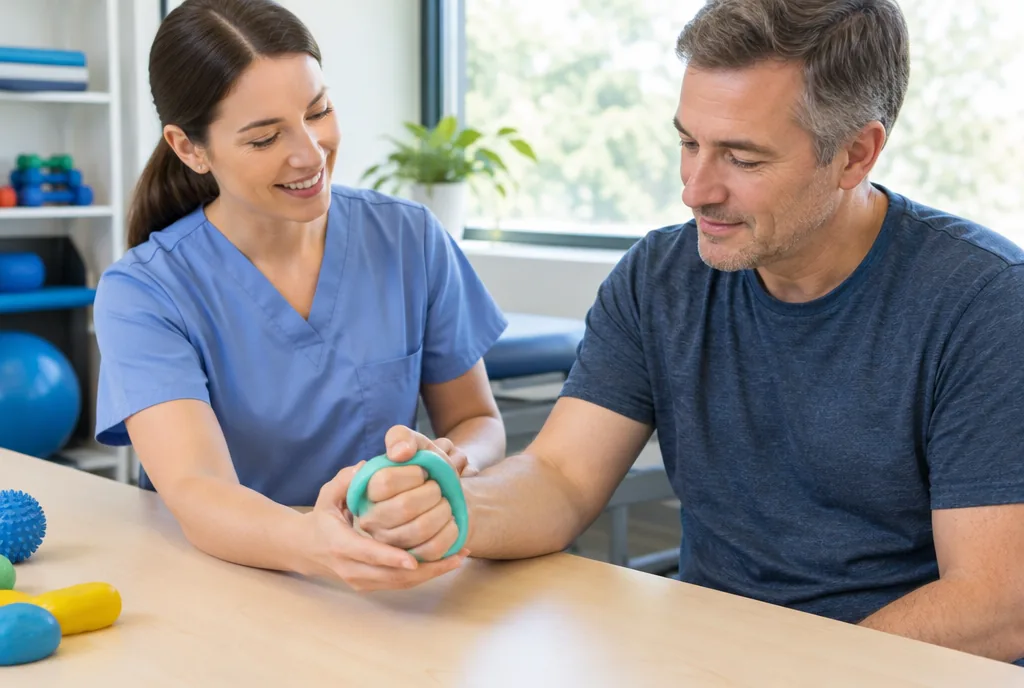
Exercises used for grip development include farmer’s walks, dead hangs, deadlifts, thick-bar pull-ups, wrist curls, plate pinches, and towel-grip variations. In neuro-rehabilitation, the right starting point and load depend on the person’s movement, function, and safety needs. A therapist can adapt strengthening work and use repeat dynamometer measurements to show whether the program is producing real change.
Frequently Asked Questions
What should my grip strength be for my age?
Use an age- and sex-matched norm table that matches the tested hand, dynamometer, and protocol. Peak values occur around ages 30–39, but a meaningful comparison requires more than age alone.
What are normal grip strength values for men and women?
Selected U.S. examples include 109.6 lb for men aged 25–29 using the dominant hand and 65.9 lb for women aged 40–44 using the dominant hand. Values decline with age, so there is no one normal number for all adults.
Is 70 lb a good grip strength?
At 31.8 kg, 70 lb is below the 10th percentile for men aged 25–29, around average for women aged 25–29, and close to average for men aged 75–79. Interpret it by age and sex.
How is grip strength measured?
A hand dynamometer measures a maximal isometric squeeze. Standard adult testing uses handle position 2, three attempts per hand, at least 15 seconds of rest, and a consistent seated posture.
What does low grip strength mean?
It can be a marker that deserves assessment, not a diagnosis by itself. Low strength is associated with sarcopenia, falls, longer hospital stays, and lower quality of life; discuss an unexpected low result with a doctor or rehabilitation clinician.